Ranthambore National Park, India
We are woken early by chanting which penetrates through to the fifth floor. Sadly, upon peering through the curtains not only do we fail to see our morning devotees but also the Taj Mahal, despite the much vaunted 'Superior Taj View' we were promised when we paid for the upgrade. It's there, just hidden by the familiar fog.
We check out and our driver Kamal is there once again. It's the third day running. For the first time he explains he'll be with us all the way to Udaipur, which pleases us as he is calm, gentle and pleasant. A friendly presence on our travels.
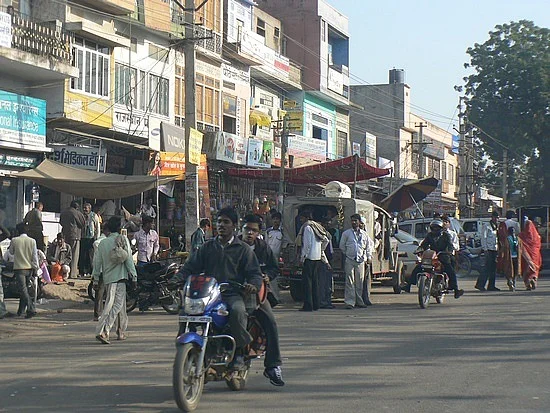
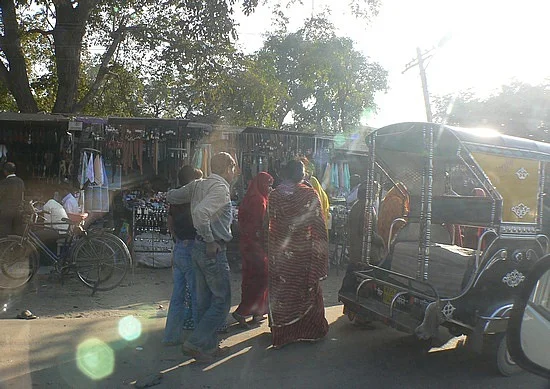
He takes us out through old Agra, full of shops and bazaars, vegetable sellers and goats, children playing in the street and teenagers on motorbikes chattering into mobile phones.
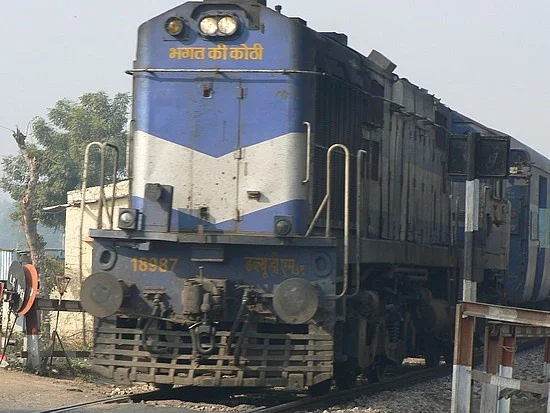
We reach the town outskirts, marked by the railway crossing, just as the barrier comes down. The train duly sails past, crammed with thousands of faces staring out of the cramped compartments, but we sit patiently for ten more minutes until anyone remembers to raise the barrier. And then all hell breaks loose as coaches, cars, rickshaws, tuk tuks, goats, motorbikes, lorries, cows, dogs, horse drawn carts, cyclists, pedestrians, buffalos and donkeys all surge forward fighting to be first through the narrow gap.
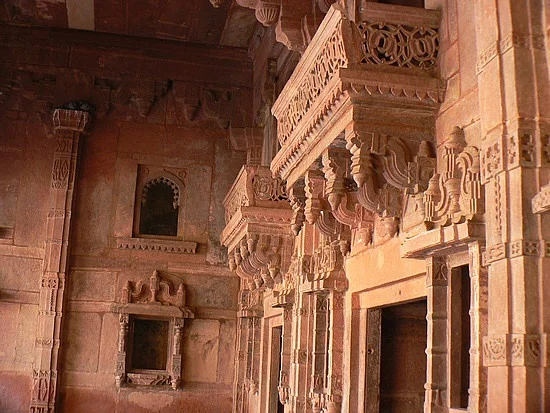
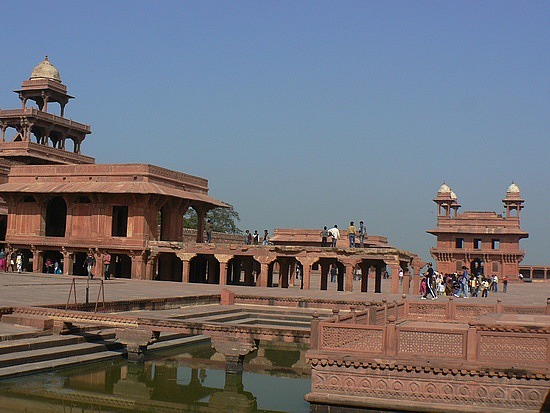
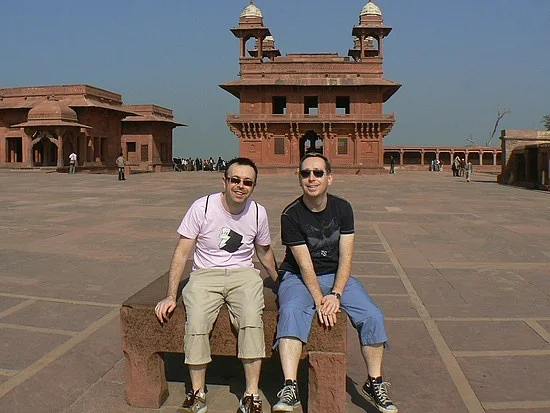
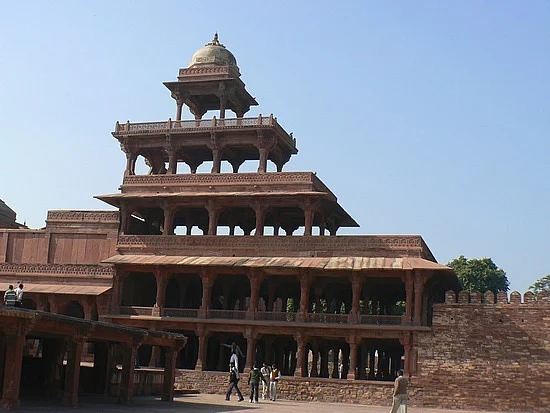
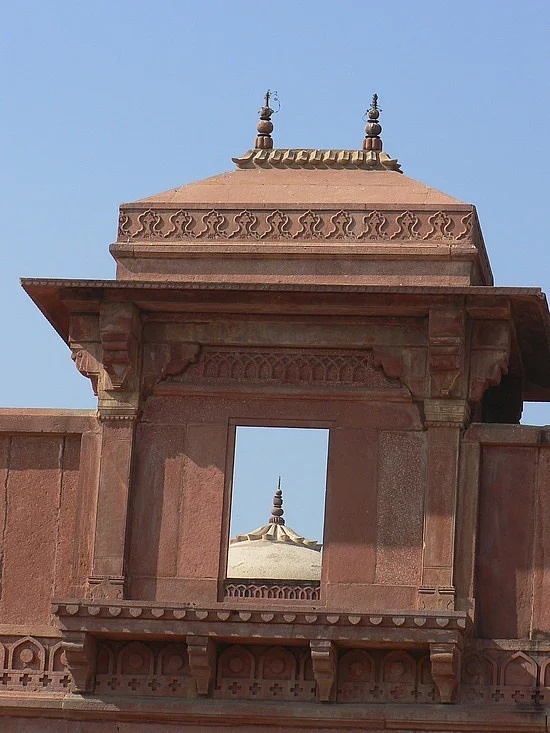
Soon after we hit the highway, a toll paying road that speeds us towards Fatehpur Sikri, an ancient palace complex built in the late 1500s by Emperor Akbhar, forefather of Shah Jahan. Outside the walls we meet up with our guide Rais once more.
Before ascending to the entrance he persuades us we should visit the loo, which seems overly precaucious as we don't yet need it. As we approach an attendant rushes towards me with hand outstretched for the obligatory rupees. I'm so startled by his sudden appearance that I miss my footing and trip over a step, landing with an almighty thud on my left knee. Immediately a livid bruise blooms violently and starts to swell. Coman helps me up, whilst berating my unwitting assailant but I'm more concerned by the camera slung around my neck which has crashed to the floor.
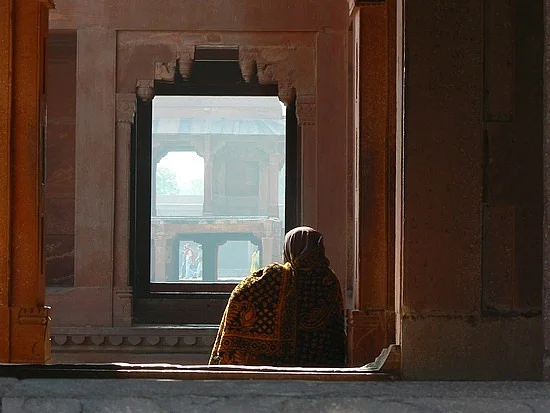
A tense few minutes later the camera proves to still be working, although with a slightly dented lens cap, and I hobble forth, ignoring the pain, determined to do justice to the splendour of Fatehpur Sikri. Rais leads us round and fortunately his rather languid pace suits me perfectly as I limp from palace to palace.
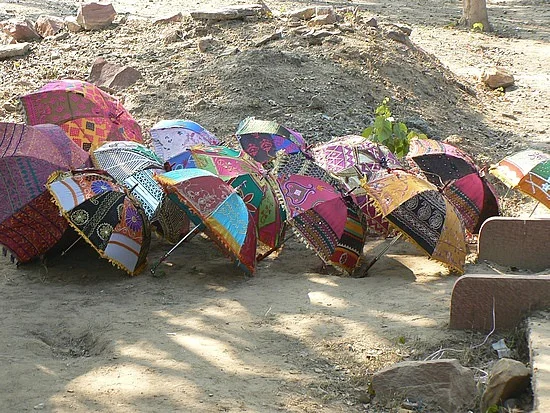
Sadly however it puts me in no mood for the vast levels of tat on offer and the street sellers, who Rais was so determined were not to be dealt with yesterday, get short shrift when they show us their wares. But today Rais has changed his tune and almost pleads with us to buy their embroidered umbrellas, ladies bags and jewellery. Turns out he lives nearby and knows all these by name (including no doubt the toilet attendant) and had been wanting us to save our money for them. Sorry Rais, it's not your lucky day.
At this juncture Rais elects to go home, rather than accompany us further and so we set off with Kamal, just the three of us once more. As we leave the state of Uttar Pradesh and pass through the pillars that mark Rajasthan the road stretches ahead for five more hours. With Kamal proving the strong silent type, we ask him if he has music. He tells us that the radio is probably not to our taste so we plump for one of his CDs. 'Kabi Kabi' is a colourful selection of Hindi music that fits perfectly with the countryside.
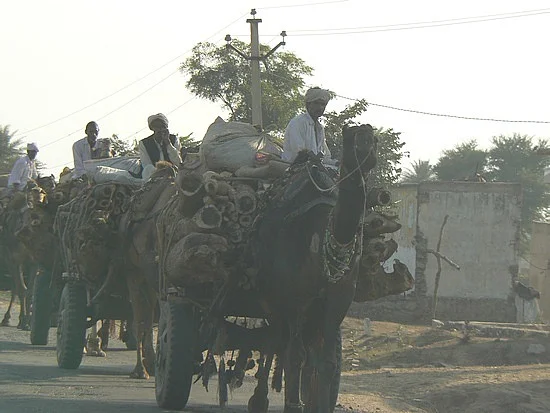
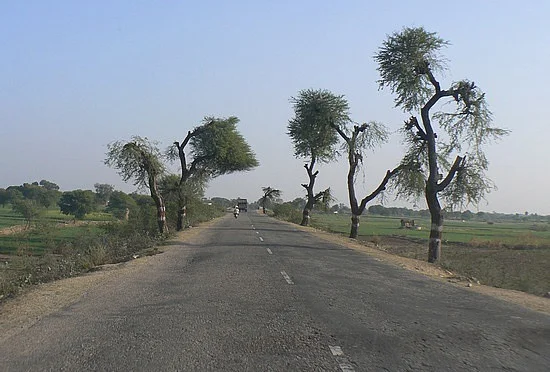
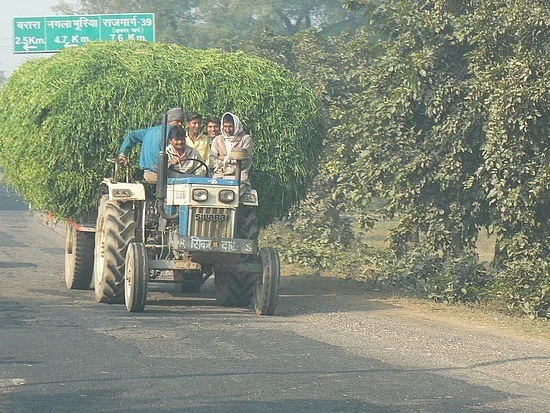
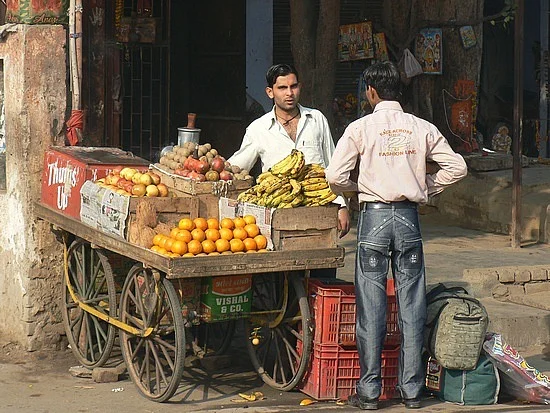
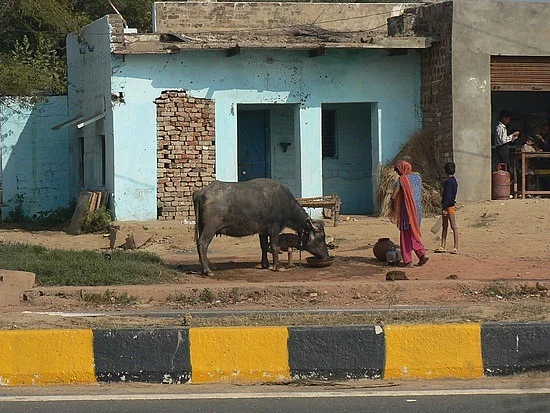
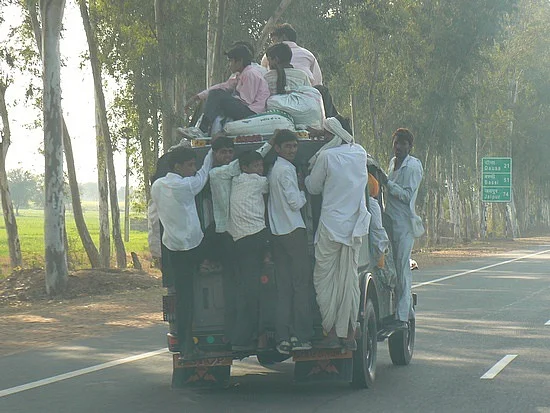
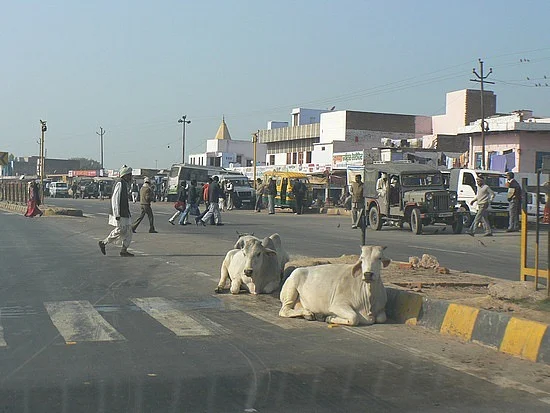
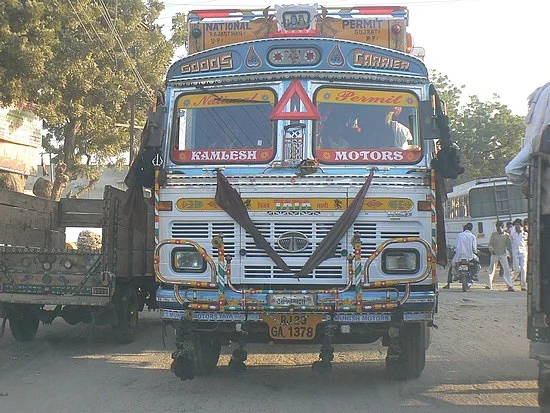
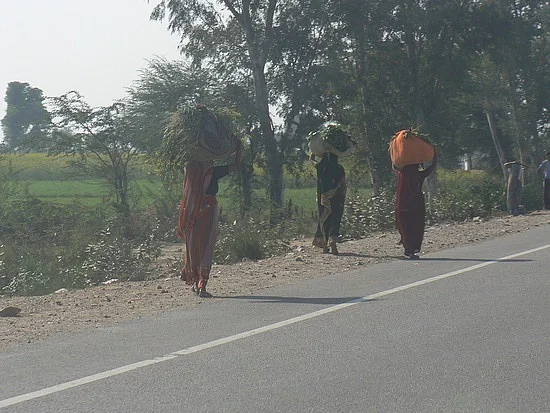
For hours we pass a continual stream of life - women carrying all manner of goods on their heads, people ploughing the fields, mud huts, monkeys, cows everywhere, stalls and shacks, dirt, dust and filth, orange sellers, nut peddlars, gaudily decorated lorries with 'Blow Horn' painted across their behinds, camels pulling carts laden with huge mountains of grass atop which headscarf-wearing herders are perched, trucks filled with people crammed into every available space. The sun bakes down and we slowly become hypnotised by the visions that parade before us.
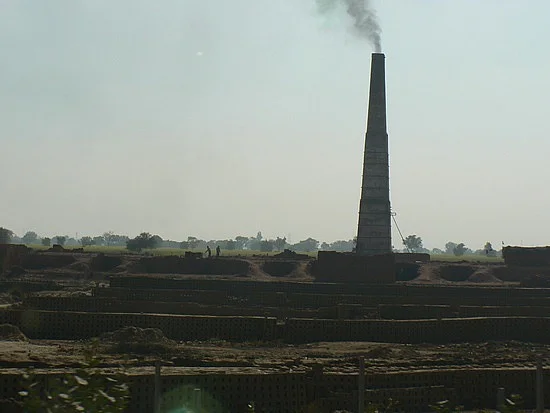
Huge chimneys belching smoke turn out to be kilns baking bricks that are then laid out in their tens of thousands beside the road. We also espy houses with huge heaps of circular turf patties piled outside. Kamal explains that it's buffalo dung, dried out, cut into shape and to be used for fuel to cook and heat. And slowly the flat plains become drier and more arid and mountains start to appear before us.
We stop for lunch at the Rajasthan Motel, another tourist spot, where fellow travellers can eat with impunity, apparently secure in the knowledge that we are safe from the fieriest chilis and nastiest bugs. For the first time Kamal accepts our entreaties and joins us. We share a creamy Kashmiri aloo dobi, spicy Fari dhal and a vegetable biriyani along with roti and naan. Fabulous fare. Kamal reveals he's actually Nepali and has been driving around India for 20 years - spending four months at a time driving tourists around the country and then a month back home in Nepal with his wife and kids on their little farm; he works to provide money so his kids can go to an English-speaking school. Humbling.
After another hour or so, during which time Kamal digs out a selection of Westernised Indian dance hits for us, we reach the city of Dhosa and turn off the Jaipur road to head southwest towards Ranthambore. Dhosa is a thronged and colourful town where the tuk tuks are stretched-out, limo style, to hold about 15 people and elaborately decorated with tinsel and braiding. They look like fairground waltzers zipping around. The afternoon sun gives the crowded city a warm glow that bathes the tents by the road and the oxen pulling carts in a golden haze.
This new road is a bumpy jolt after the relatively smooth Agra-Jaipur highway. Pitted and un-tarmacked in parts it cuts through an arid landscape, reminiscent of north Africa, as we traverse the fringes of the Rajasthani desert. Everywhere the locals wave and smile, with children running alongside the car.
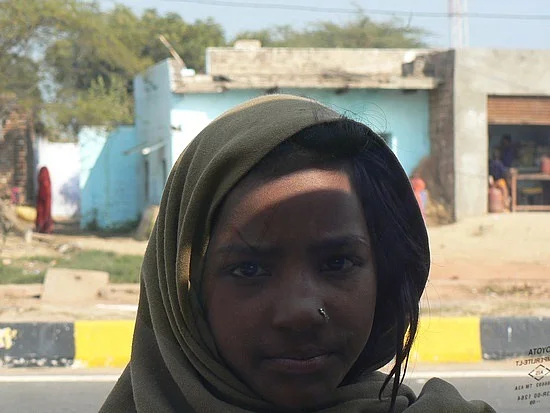
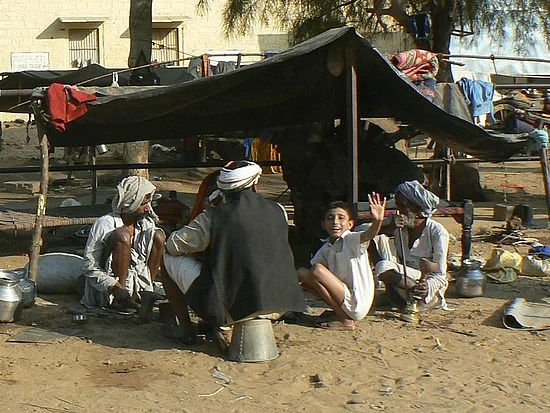
We pass through towns and villages, showing people eking out an existence on the very lowest rungs of poverty. Girls pull on the water pumps and women work the fields while the men seem to gather under trees, smoking, drinking chai and discussing matters of the day. At one village we discover the whole population gathered watching a game of cricket.
After an hour we reach the town of Lal Sot, one of the larger communities and it feels almost biblical - ancient crumbling buildings, barefoot crowds in tattered clothing and cows, goats, monkeys, camels, pigs, dogs and donkeys everywhere. Although I'm sure they weren't dodging lorries and motorbikes back in the day. And as we continue on the potholed roads we have several near-death misses swerving to avoid lorries two abreast heading towards us, and overloaded buses with people piled high on the roof who wave cheerily, inches away from instant reincarnation.
As the sun starts to set, an orange orb in a clear sky, we reach Ranthambore, just in time for the Bollywood tunes to reach a crescendo with quite a surprise. Kamal cranks up his favourite hit which consists of a woman telling us she's a "sexy naughty bitch" over various groans and moans. It's like Donna Summer meets Shilpa Shetty. Kamal sings happily along as Coman arches an eyebrow.
The light is fading when Kamal finally pulls off the road and takes us down a dusty path at the end of which our lodging for the next two days reveals itself. Welcome to Khem Villas!